
Founder guide
Best platforms to start a beverage brand
The real categories of platform for launching a drink: beverage co-packers and contract bottlers, private-label beverage suppliers, formulation houses and flavor labs, pilot-scale self-production, store builders paired with separate sourcing, and Dough. What each one covers and where it stops.
Direct answer
Six routes exist for starting a beverage brand, not one. A co-packer or contract bottler fills your formula on their line. A private-label supplier relabels a drink it already makes. A formulation house develops the recipe. Pilot-scale production means making it yourself. A store builder sells a drink you sourced elsewhere. Dough turns a described drink into a container design, a priced storefront, and a manufacturing path in one account.
At a glance
| Decision | Dough | Assembled stack: formulation house, co-packer, store builder |
|---|---|---|
| What you need before you start | A written description of the drink you want to sell | A finished formulation, a process authority letter, a booked co-packer, and print-ready artwork |
| Product, container, and brand design | Drafts with product design, packaging concept, and brand, refined in plain language | Separate briefs to a flavor lab, a designer, and a can supplier, reconciled by you |
| Unit economics | Unit cost and remaining margin shown behind the price you publish | A spreadsheet fed by liquid, container, fill, freight, and storage quotes that arrive at different times |
| Testing demand before inventory | Waitlist or pre-orders held in escrow, refunded if the threshold is not met | Assembled from apps once a store and a funded production run both exist |
| Manufacturing | Sampling, production with vetted manufacturers, and fulfillment in the same account | Sourced, negotiated, and scheduled by you across a lab, a filler, and a container supplier |
| Process filing, shelf life, and label compliance | Yours, with your process authority and facility | Yours, with your process authority and facility |
| Ownership | You own the business fully and Dough takes no equity | Set by each contract and platform agreement you sign |
| Cost to begin | One plan at $29 per month plus a share of what you sell, no setup fee | Lab fees, artwork, container tooling or plates, platform fees, and a minimum run committed before revenue |
The six routes you are actually choosing between
A search for a beverage platform returns six categories of thing that are not comparable to each other: a factory, a relabeling supplier, a laboratory, a rented kitchen, commerce software, and a platform. Sorting them into categories is the first useful step, because each category solves a different part of the job and none of them solves all of it alone.
Beverages carry the harshest production economics of any consumer product category, which is why the choice matters more here than it does in apparel or accessories. A drink is a regulated thermal-process food, it is bought into a container that has its own minimum, it is heavy to move, and it has a shelf life that starts running the day it is filled. Every one of the six categories below is defined by which of those four facts it absorbs for you and which it hands back.
- Beverage co-packers and contract bottlers: they fill your formula on their line
- Private-label beverage suppliers: they sell you a drink they already produce, with your label on it
- Beverage formulation houses and flavor labs: they develop the recipe and the specification
- Home and pilot-scale production: you make the product yourself in licensed space
- Store builders plus separate sourcing: they sell a drink that already exists
- Dough: product concept, container and brand design, priced storefront, and manufacturing in one account
What a beverage co-packer or contract bottler will and will not do
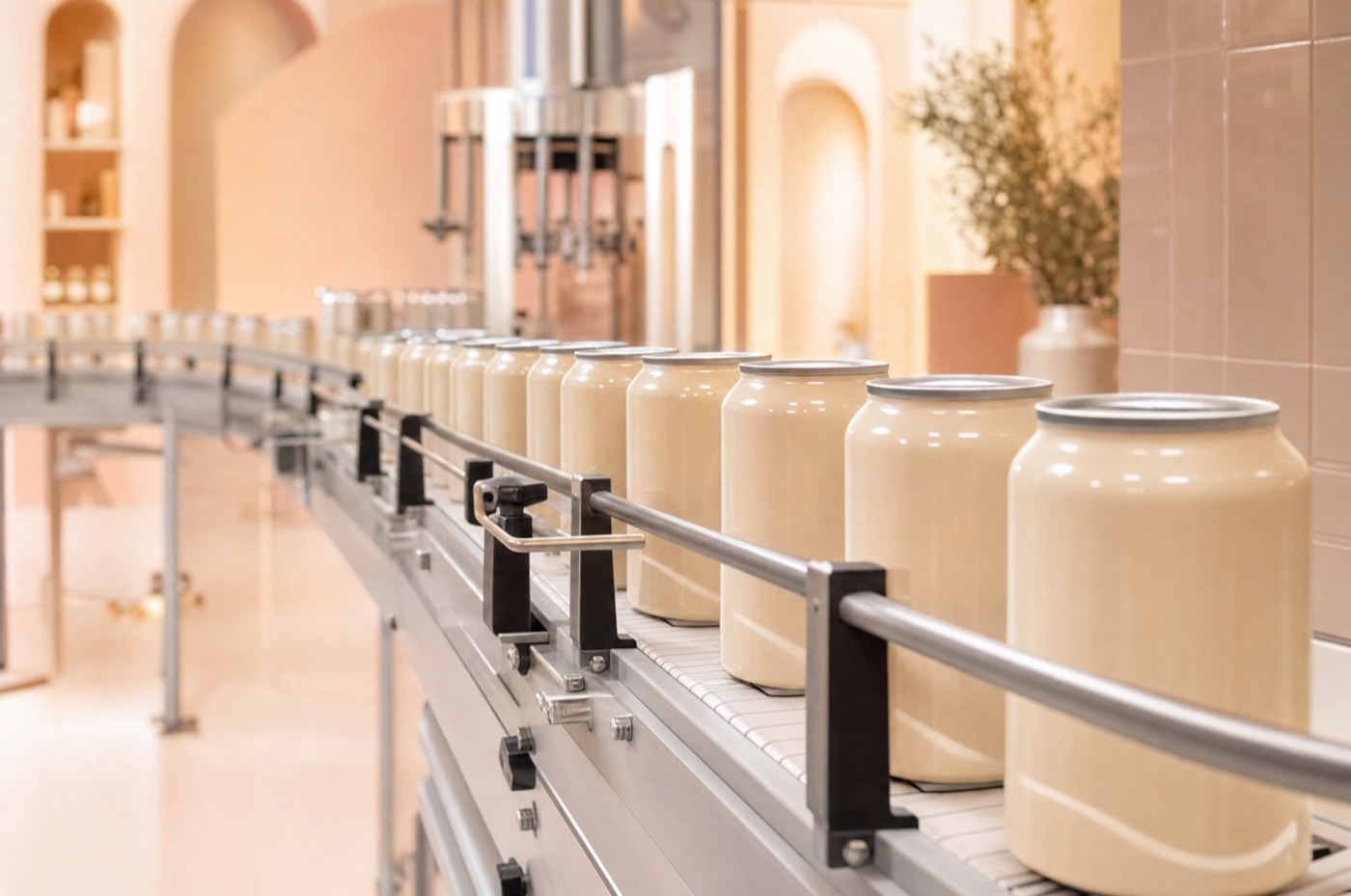
A beverage co-packer runs your formulation on their filling line and hands you finished, sealed, labeled units. The reason the category exists is that a fill line is capital equipment with a validated thermal process attached to it, and the filing, the inspection history, and the seam control behind it are infrastructure that cannot be reproduced quickly. A co-packer is the only one of the six categories that turns a recipe into pallets.
A beverage co-packer stops at everything that is not the fill. A co-packer will ask you for a formulation in weights and percentages, a process authority letter specifying the thermal process, print-ready artwork to their die line or sleeve specification, a container decision, and a purchase order for a minimum run quoted in cases or pallets rather than units. A co-packer will not name your drink, position the flavor, design the can, tell you what to charge, or find a buyer for the run they just filled.
- Ask which processes the line actually runs: hot fill, cold fill with preservatives, tunnel or flash pasteurization, aseptic, or retort
- Ask whether the facility is registered for low-acid canned foods or acidified foods, and who files the scheduled process
- Ask for the minimum first run, the reorder minimum, and the changeover charge as three separate numbers
- Ask whether they procure cans, ends, closures, sleeves, and ingredients or expect you to deliver them to the dock
- Ask to see double seam teardown records if you are canning, because seam integrity is what shelf stability rests on
Co-packing minimums and container minimums are two different commitments from two different vendors, and the container minimum is frequently the larger of the two.
What a private-label beverage supplier gives you and what it costs you
A private-label beverage supplier sells you a drink they already produce, under your brand. The formulation is already developed, the thermal process is already filed, the shelf life is already established, and the container is already tooled, which is why a private-label beverage supplier is the fastest route from decision to sellable inventory in the category.
A private-label beverage supplier stops at differentiation. The base formula belongs to the supplier and is sold to other brands from the same tank, so your competitor can buy the same liquid and compete with you on price. Flavor tweaks, functional additions, and sweetener changes are usually offered from a fixed menu rather than developed, and the container is whatever the supplier has tooled. What you are buying is a validated product with your name on it, and the constraint you accept is that the product is not uniquely yours.
- Ask whether the base formula is exclusive, semi-exclusive, or open
- Ask which specification elements you may change: flavor, sweetener, color, caffeine, container, fill volume
- Ask for the shelf life on the existing production record rather than an estimate
- Ask whether the supplier holds the process filing, because that filing does not travel with you if you leave
What a beverage formulation house or flavor lab does
A beverage formulation house or flavor lab develops the liquid itself and produces the documents a factory needs. The deliverable from a formulation house is a specification: an ingredient statement, weights and percentages, a target Brix and titratable acidity, a finished pH, a viscosity and turbidity profile, a color standard, and stability data. A flavor lab within that process builds the flavor system, masks off-notes from botanicals, proteins, or high-intensity sweeteners, and matches the flavor to survive the heat the process will apply.
A beverage formulation house stops before manufacturing and before commerce. A formulation house does not own a filling line, does not carry your minimum, does not design your can, does not price your product, and does not sell it. A process authority review, which is a separate service and sometimes a separate firm, is what converts a formulation into a scheduled process that a co-packer can legally run. Founders often discover the sequence in the wrong order: the lab bench sample tastes correct, and then the thermal process the co-packer actually runs changes it.
Flavor moves twice: once during processing and again during storage. A formulation is finished when it has been tasted from a production run at age, not when it tastes right at the bench.
Home and pilot-scale beverage production: what it is good for
Home and pilot-scale production means making the drink yourself in licensed shared kitchen, commissary, brewery, or pilot-plant space. Pilot-scale production is the only route that lets you iterate on the recipe in days, produce at genuinely small volume, keep the formula in your own hands, and sell into farmers markets, taprooms, and local accounts while the flavor is still moving. Many established beverage brands started exactly here.
Home and pilot-scale production stops at shelf stability and at scale, in that order. Hand-filling produces inconsistent fill volume and headspace, and net quantity of contents on a label is a legal declaration rather than an approximation. A hand-operated or bench can seamer has to be set and checked, because a seam that looks closed and is not is a spoiled or unsafe product. A low-acid or acidified beverage needs its finished pH established and its process reviewed regardless of batch size, and refrigerated or cold-pressed products made without a validated kill step carry a cold chain obligation from your door to the customer.
- Bench seamer setup, seam micrometer checks, and teardown records if you are canning
- Finished pH measurement on every batch, recorded, not assumed
- Lot coding and date coding on every unit, because a recall without lot codes is a total recall
- Cold chain for anything relying on refrigeration rather than a kill step
Store builders paired with separate beverage sourcing
General ecommerce platforms such as Shopify, WooCommerce, BigCommerce, and Squarespace are the default answer founders arrive at, because the store is the visible part of a brand. Store builders are genuinely mature at the commerce layer: checkout, payments, tax, shipping rate calculation, subscriptions, discount codes, and email are all well documented and well supported.
A store builder assumes the entire product problem is already solved. The store is empty until a formulation, a process authority letter, a co-packer booking, a container, a compliant label, and physical inventory all exist somewhere else. The sourcing lives in a different tool, the costing lives in a spreadsheet, and the price on the product page is typed in by hand, which is how published prices and real landed costs drift apart. Beverages have a specific trap here: liquid is dense and containers are fragile, so parcel shipping a single unit routinely costs more than the unit, and a store builder will publish that price without ever mentioning freight.
What Dough covers across the whole beverage path
Dough starts where the drink is still a sentence. You describe the format, the flavor, the functional angle, the occasion, and who is drinking it, and Dough returns several drafts, each with a product design, a packaging concept, and a brand. You refine drafts in plain language and nothing is committed until you pick one. Drafts come in two shapes: a catalog product that a manufacturer in the network already makes, which is faster and cheaper, and a custom product that needs real development work, which is slower and costs more.
Building the draft publishes a storefront on its own address. You set the price, and Dough shows the unit cost and what each sale leaves you before you commit, so the price and the cost are not maintained in two places. The storefront can collect waitlist signups or pre-orders before anything is manufactured, with pre-order funds held in escrow and customers refunded if the threshold is not met or the product cannot be delivered. Then sampling, production with vetted manufacturers, and fulfillment, with ads and analytics in the same account.
Design and brand lock when the product is built, which is the tradeoff worth naming: refinement happens on drafts, not after. You own the business fully and Dough takes no equity. Pricing is one plan at $29 per month plus a share of what you sell, with no setup fee. Dough also runs a public MCP server, so the same workflow can be driven from Claude or any MCP client in a chat.
What Dough does not do for you: the food-safety and regulatory work. Your finished pH, your process authority review, your scheduled process filing, your shelf-life study, and your label compliance sign-off stay with you and your facility in every one of the six categories.
The beverage specifics any platform has to survive
The same category-specific facts decide whether a beverage can legally and economically exist, whichever of the six routes you take. The first is classification: a beverage is either an acidified food, a low-acid canned food, or naturally acidic, and finished pH is the number that decides which. Acidified and low-acid canned foods pull in facility registration, a scheduled process filed with the agency, process records, and trained operator requirements, and those obligations do not scale down with batch size.
The second is the process, and there are five in common commercial use for beverages. Hot fill, where the product is filled hot into a heat-set container. Cold fill, which relies on preservatives, acidity, or a downstream step. Tunnel or flash pasteurization, applied in or before the container. Aseptic, where a sterile product meets a sterile container. Retort, where the sealed container is cooked. High pressure processing, or HPP, sits alongside these as a non-thermal step used for cold-pressed juice and other products that would lose their character to heat, and HPP carries a cold chain rather than removing one.
The third is the container, and each format implies its own tooling and its own minimum. Aluminum cans require a seamer, a matching end diameter, and either printed cans or blank brite cans decorated with shrink sleeves. Glass requires a crown, ROPP, or lug closure and carries weight and breakage. PET requires a preform and a heat-set decision if the fill is hot. Cartons and pouches require their own dedicated aseptic lines. Choosing printed cans versus sleeved blanks is the single decision that most changes what your first run costs, because printed cans carry a separate and typically larger minimum from the can supplier.
- Label elements: statement of identity, net quantity of contents, ingredient list in descending order by weight, declaration of the major food allergens defined in US law, nutrition facts panel subject to small-business exemption conditions, and the name and place of business of the responsible party.
- Allergen declaration covers milk, eggs, fish, crustacean shellfish, tree nuts, peanuts, wheat, soybeans, and sesame, and a beverage triggers these through protein, dairy, oat, soy, and nut bases as readily as a food does.
- Alcohol changes the agency: beer, wine, and distilled spirits fall under the Alcohol and Tobacco Tax and Trade Bureau, which requires formula approval and a Certificate of Label Approval, while most non-alcoholic drinks and some malt beverages made without malted barley and hops fall under the FDA.
- Container deposit and recycling marks: container deposit states require specific deposit legends on the label, and recycling marks such as the resin identification code and the How2Recycle label carry their own placement and substantiation rules.
- Distribution structure: retail beverage sales run through distributors or direct store delivery, and slotting, promotional allowances, and scan-back deals are negotiated per chain and quoted per store per item.
- Freight and weight: a beverage is priced by weight and cube, so the case count, the pack size, and the pallet configuration are commercial decisions freight makes for you before you design the packaging.
How to compare beverage platforms in one week
Run one test rather than reading more comparisons. Push your actual drink idea through each candidate stack until you reach two specific artifacts: a number you would print on a price tag at a real pack size, and a page a stranger could buy from. Write down every point where you had to retype a figure by hand or invent one you did not have.
Those points are the true cost of a stack and they never appear on a feature list. A formulation house produces a specification and stops. A store builder produces a checkout with nothing behind it. A co-packer produces a quote that assumes a dozen decisions you have not made. A private-label beverage supplier produces a drink other brands are also selling. Compare the six categories on how far each one carried the idea before it handed the problem back to you, and on which of the four beverage constants it absorbed: process, container minimum, weight, and shelf life.
For the production and compliance sequence itself, rather than platform selection, see the companion guide on how to start a canned drink brand linked in the sources below.
What changes about the order
- Getting to something people can react to
- UsuallyA drink is hard to describe without showing it, so artwork and a container decision come before anyone has reacted to the concept.
- With DoughThe container design, the brand, and the storefront exist as soon as you describe the drink, so showing it costs nothing to produce.
- Deciding pack size and price
- UsuallyPack size is discovered after freight quotes arrive, which often forces a repackage, a reshoot, and a new price.
- With DoughThe price is set against a visible unit cost at a real pack size, so weight shapes the product before the artwork is finished.
- Committing to the first fill
- UsuallyA run denominated in cases or pallets is funded on conviction, then the flavor and the price are tested against the market afterwards.
- With DoughPre-orders against a launch goal produce the demand signal first, and the production run answers it.